
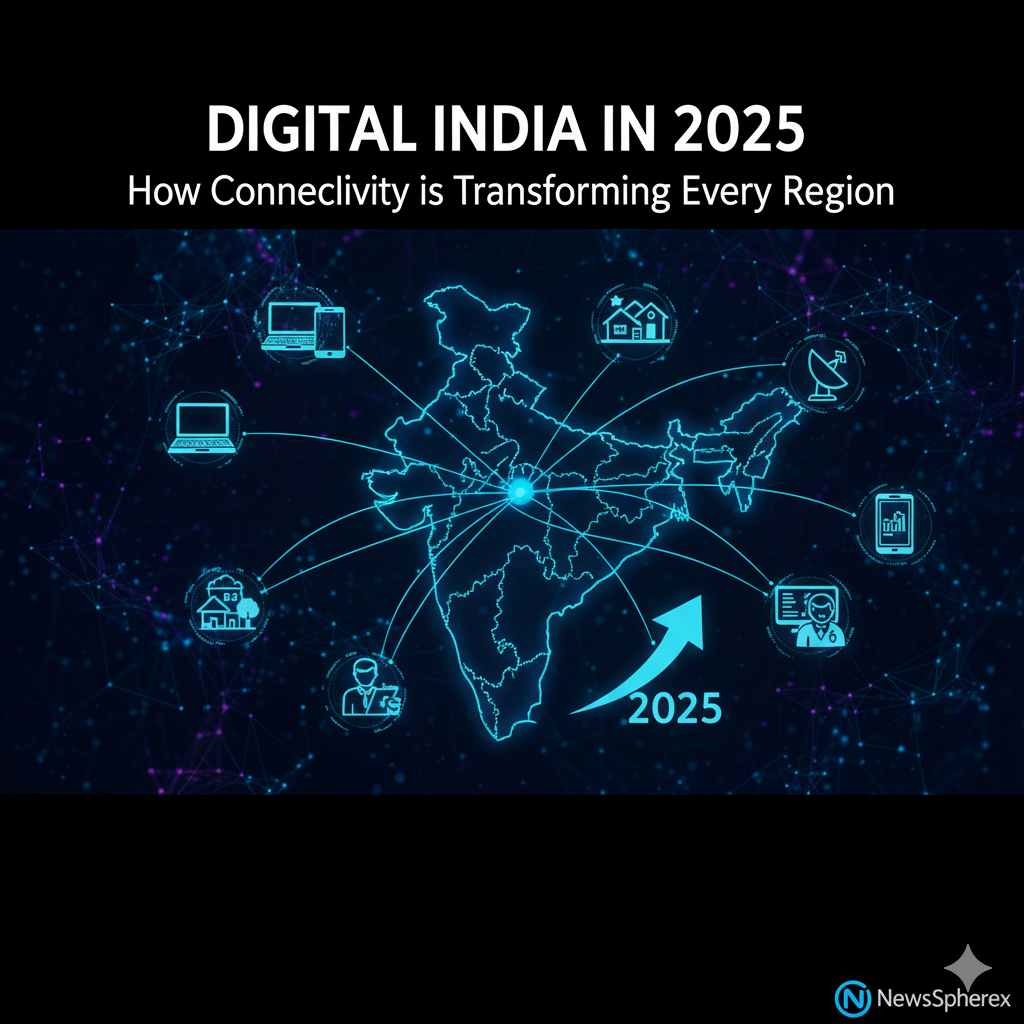
Digital India 2025: How Connectivity Is Transforming Every Region


Introduction: Why “Digital India” Is Evergreen
A decade ago, “digital” in India mostly meant metro users streaming videos and shopping online. Today, digital services reach haats, small towns, and remote villages. UPI payments at tea stalls, telemedicine for district hospitals, online classes in semi-urban schools—these are no longer exceptions, they’re everyday experiences. That’s why the story of Digital India is evergreen: connectivity continues to deepen, and opportunities keep expanding across regions, languages, and income groups.
Digital India isn’t only about faster internet—it’s about inclusion, empowerment, and reducing distance between citizens and services.
This post maps the journey, highlights region-wise impact, explains benefits by stakeholder, and offers practical steps to participate safely and confidently. It’s designed to rank for terms like digital india 2025, digital inclusion india, and regional connectivity india—while staying useful for years.
What Is Digital India? The Pillars That Matter
Launched to transform India into a knowledge economy and digitally empowered society, Digital India brings government services, identity, payments, learning, and healthcare into every citizen’s palm. While schemes evolve, five enduring pillars define its impact:
1) Infrastructure
Broadband highways (e.g., fiber to gram panchayats), public Wi-Fi hotspots, and last-mile mobile connectivity that turn villages into connected nodes.
2) Digital Identity & Records
Aadhaar, DigiLocker, and unified service portals help citizens prove identity and store documents securely online.
3) Payments & Commerce
UPI, QR codes, AePS, and micro-ATMs enable instant, low-cost transactions—even for those new to formal banking.
4) e-Governance
From utility bills to land records, birth certificates to scholarships—government services move online, reducing queues and leakages.
5) Digital Literacy
Programs, NGOs, and schools build awareness around using apps, protecting data, and accessing services in local languages.
Regional Rollout: Metro to Tier-3 & Rural
Connectivity started with metros and IT hubs (Delhi NCR, Mumbai, Bengaluru, Hyderabad, Chennai, Pune). Over time, Tier-2 cities like Coimbatore, Jaipur, Lucknow, Indore, and Bhubaneswar emerged as strong digital adopters. Today, Tier-3 towns and rural blocks are fast followers, supported by common service centres (CSCs), mobile networks, and community champions.
Urban Trends
- QR payments everywhere (kirana, cabs, clinics).
- Telemedicine & e-pharmacies for quick consults and deliveries.
- e-Governance portals reduce in-person visits; appointments move online.
- Ed-tech and certification courses for upskilling across professions.
Semi-Urban & Rural Trends
- UPI adoption by small merchants & self-help groups.
- Agri-apps for mandi prices, weather alerts, and crop advisory.
- Online learning via mobile, community centres, and school labs.
- Tele-consults connecting PHCs/CHCs with district specialists.
The pattern is clear: once a community trusts digital identity and payments, other services (health, education, commerce) take off.
Benefits by Stakeholder
| Stakeholder | What They Gain | Everyday Example |
|---|---|---|
| Citizens | Faster access to services, less travel, better documentation | Download birth certificate via DigiLocker; pay bills with UPI |
| Students | Quality content, scholarships, competitive prep | Attend live classes on a budget smartphone |
| Farmers & SHGs | Price discovery, direct-to-customer channels, micro-credit | Sell produce online, receive subsidies in bank accounts |
| Small Businesses | Cash-flow visibility, lower costs, wider reach | QR payments reduce cash handling; online catalogs boost sales |
| State & Local Govts | Data-driven planning, transparent delivery | Online grievance redressal; targeted welfare transfers |
Real Use Cases Across States
Kerala & Tamil Nadu: Service Density + Literacy
High literacy and robust local governance enable quick adoption: citizens renew licenses online, hospitals integrate tele-consults, and MSMEs market globally through marketplaces and social commerce.
Karnataka & Telangana: Startup Hubs Spill Over
Ecosystems in Bengaluru and Hyderabad seed digital culture in neighboring districts—co-working spaces, logistics networks, and skill programs spread to Mysuru, Hubballi–Dharwad, Warangal, and beyond.
Maharashtra & Gujarat: MSME Digitization
Manufacturing clusters use e-invoicing, digital procurement, and UPI-linked payroll; urban cooperatives and SHGs use apps for bookkeeping.
Northeast & Himalayan States: Terrain Meets Tech
Tele-health, online education, and e-commerce solve distance barriers; community centres become digital hubs for documentation and payments.
Hindi Belt & Eastern Corridors: Scale + Vernacular
Rapid growth in Hindi, Bangla, and Odia content unlocks new internet users; voice search and short-form video help first-time adopters navigate services.
Key Challenges & What’s Missing
- Connectivity gaps: Some habitations still lack stable broadband or reliable power.
- Device affordability: Multi-user households need shared devices; schools need lab refresh cycles.
- Service fragmentation: Too many portals and passwords overwhelm new users.
- Trust & grievance redressal: Users need clear, fast dispute resolution for payments and service failures.
- Cyber risk: First-time users face phishing/OTP scams; merchants need chargeback education.
Security, Privacy & Digital Literacy
A safe digital journey needs habits as much as hardware. Whether you’re a student or a sarpanch, the same basics apply:
- Never share OTPs or passwords; verify handles before sending money.
- Use strong passcodes/biometrics; keep OS and apps updated.
- Prefer official apps and verified links; avoid public Wi-Fi for payments.
- Back up documents to trusted cloud (e.g., DigiLocker) and keep paper copies for critical records.
For merchants, reconcile UPI settlements daily, display official QR codes prominently, and train staff to spot refund scams.
What’s Next: 5G, Edge, LEO & Vernacular Web
5G & Fixed Wireless
Home broadband for towns without fiber; better video consults and interactive learning; reliable connectivity for SMEs.
Edge Computing
Local processing for low latency—useful for precision farming, CCTV analytics, and smart factories in tier-2 clusters.
LEO Satellite Backhaul
Bridging remote valleys and islands; disaster-resilient links for health and governance services.
Vernacular & Voice
Growth accelerates as services speak local languages; voice bots and IVR simplify discovery and support.
Expect regional creator economies, digitized cooperatives, and IoT-powered agri & logistics to define the next wave.
Actionable Checklist for Citizens & SMEs
For Citizens
- Link mobile to Aadhaar and bank; set up UPI with a daily limit you’re comfortable with.
- Use DigiLocker for licenses, marksheets, and certificates; share via secure links.
- Install official state apps (e.g., transport, land records, utility boards) and bookmark portals.
- Enable two-factor authentication on email and messaging apps.
For Small Businesses
- Adopt UPI QR + soundbox for transparency; reconcile payouts daily.
- Create a simple catalog site or WhatsApp catalog; list on local discovery platforms.
- Digitize invoices and inventory; back up business data weekly.
- Train staff on scam patterns; document refund policies clearly.
FAQ: Digital India & Regional Connectivity
Is Digital India only about cities?
No. The biggest gains now come from semi-urban and rural adoption—UPI at small shops, telemedicine at PHCs, and e-governance at CSCs.
What do I need to start using digital government services?
A mobile number, basic ID (often Aadhaar), and access to official portals/apps. Store documents in DigiLocker for easy, secure sharing.
How can small shops benefit without a website?
Start with UPI QR, a WhatsApp product catalog, and listings on local discovery apps. Add a simple one-page site later for trust and search visibility.
What’s the safest way to use UPI in rural areas?
Keep your UPI PIN confidential, verify the receiver’s name before paying, set daily limits, and avoid sharing OTPs or screen-sharing with strangers.
Conclusion
Digital India’s regional story is ultimately about access and agency. As connectivity spreads and services become simpler, every district can participate in the digital economy—earning, learning, healing, and governing better. The road ahead combines infrastructure with literacy, security with trust, and national platforms with local needs. If citizens and small businesses embrace safe digital habits today, India’s next leap will be broad-based and genuinely inclusive.